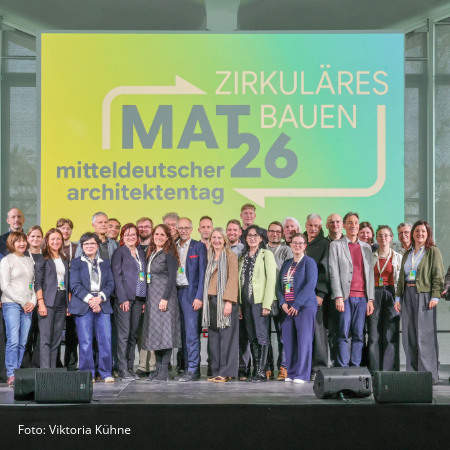
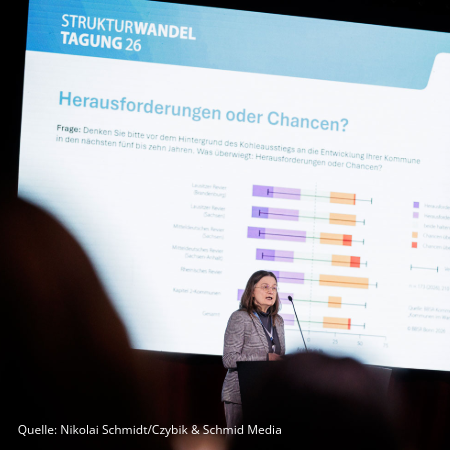
About 350 guests from coal-mining regions gathered in Halle (Saale) on November 16 and 17, 2026, for the 4th Federal Conference on Structural Change. The focus was on how transformation can succeed when jobs are lost, municipal budgets are shrinking, and local residents still need a sense of optimism. The event was held under the theme “Shaping Structural Change Together—Future Prospects in Turbulent Times.”
The organiser was the Competence Centre for Regional Development (KRE) at the Federal Institute for Research on Building, Urban Affairs and Spatial Development (BBSR), together with research institutions and regional partners. The focus was on coal regions and other transformation regions such as the Saarland, the Ruhr area and southwestern Saxony. Among the participants were numerous Saxony-Anhalt NEB_PROJECTS from the state initiative "Together for a New European Bauhaus #NeueBauhäusler", including the Heimatforschernetz Burgenlandkreis in Deuben, the Reallabor ZEKIWA Zeitz (RZZ), the Gemeinschaftsamt in Halle (Saale) and the Zentralstation Zeitz.
The focus was on local governments, which are driving change at the local level and are coming under increasing pressure as a result. This is confirmed by the initial findings from the second round of the BBSR municipal survey “Local Governments in Transition 2026,” conducted by KRE. The survey included the 650 cities and municipalities in the areas eligible for funding under the Coal Regions Investment Act (InvKG). Conclusion: Compared to two years ago, they now see structural change as presenting fewer opportunities for themselves. About 90 percent expect their financial situation to deteriorate somewhat over the next five years. In roughly 80 percent of the municipalities, existing administrative staff have taken on the tasks associated with structural change in addition to their regular duties, leading to overwork. About two-thirds would like more guidance on budgetary and financing issues, as well as support in developing and implementing projects. KRE Director Dr. Carola Neugebauer emphasized that structural change cannot be achieved through funding programs and investments alone, but rather, above all, where people, municipalities, and regions are strong partners and have reliable framework conditions and sufficient resources.
Many of the contributions underscored just how much this depends on the local people. When jobs are lost, factories close, and business tax revenues decline, it is precisely the “voluntary services” provided by municipalities—such as support for culture, clubs, or community centers—that help determine whether a place remains a good place to live, both for long-time residents and for well-qualified professionals moving in. Christine Herntier, spokesperson for the Lausitzrunde and mayor of Spremberg, articulated people’s expectations: They do not want the prospect of improvements in ten years’ time; structural change must become tangibly positive right now. Stefan Kipfelsberger, head of the “Structural Change in the Central German Mining Region and Coordination Office for Funding Policy” division at the State Chancellery of Saxony-Anhalt, made a corresponding call to action. It must be evident: “Structural change is happening there!” Civic participation plays a major role in this. Christine Herntier summarizes it in the guiding principle: “From participation to understanding to acceptance.”
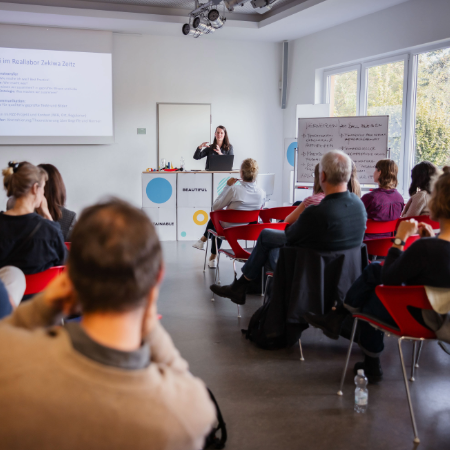
In the workshops and forums that followed, participants engaged in practical discussions, and on the afternoon of the first day, the REVIERPIONIER networking event took place. This event also marked the kickoff for the REVIERPIONIER 2027 ideas competition, “For the Future, the Region, and Its People.” As with the NEB_INITIATIVE projects and their values—BEAUTIFUL: SUSTAINABLE: TOGETHER—this ideas competition focuses primarily on local people, on coming together, getting involved, and making a difference through self-directed action. This is entirely in line with Christine Herntier’s motto: You start with participation, build understanding, and thereby gain acceptance.
Now in its fourth year, the Structural Change Conference has established itself as a nationwide meeting place for stakeholders in regions undergoing transformation. It provides a forum for contextualizing developments across the boundaries of individual regions and fields of expertise, exchanging experiences, and jointly developing solutions.
Further information about the conference is available in the follow-up report by the BBSR.